In the BeforeHere, the BeforeNow, an angry scream sounded, and He radiated in every direction, expanding the boundaries of TheHereAndNow. ThePath, then, walked Herself into existence, circled around and throughout TheScream—searching for ways to soothe His quivering pain. TheScream, fearing He would be muffled and silenced forever by “this attack,” beamformed pulsating retaliation—directed at ThePath. ThePath, thus beset, forked at that point into countless alternatives and determined the best one for going forward; she reacted accordingly and tore Herself and the dissonance of TheScream apart into smaller, heated melodies. These slowly cooled into a more agreeable universe of solar bodies and smaller, more soulful personifications. Multiple such recreatons may have happened since then.
The Known Solar System today consists of a Sol-like sun (Freehet), an elemental inner planet (Shuekra), a warm fluffy gas giant (EyeQweetas), and two outer planets (Enyoe and Furantur). EyeQweetas supports four tidal-locked moons: Nodebra, Leeka Sinada, Kree Hweef, and Ooveraree. All celestial objects in the solar system—including empty space (Reynon) and a nearby bright realmstar (Vhereum)—serve as avatars for (and are named after) the gods who exist currently.
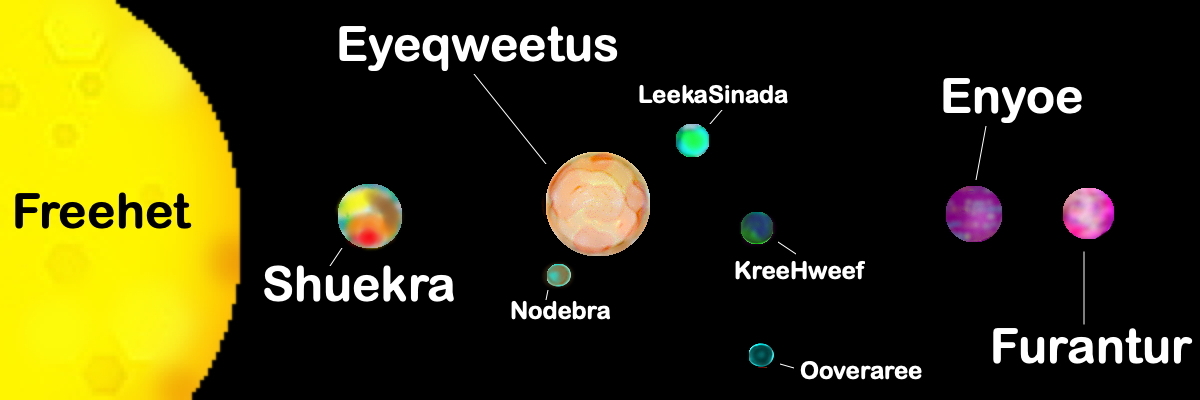
TheWorld (a.k.a. Leeka Sinada) is a tidal-locked moon, believed to be 3,600 miles in diameter, with a very large, very dense metallic core. It orbits EyeQweetas, a low-density, warm fluffy gas giant roughly 60,000 miles in diameter, which is about 1.32 AU away from its sun (Freehet). “ThePeople” is a generic reference for the various sentient creatures populating TheWorld (primarily humans, but also including halflings, elves, goblins, ogres, dwarfs, gnomes, and others). Most known life and civilization is concentrated on the ocean-dominated dayside on the moon facing EyeQweetas, centered around a roughly 750-mile-wide central landmass at the sub-EyeQweetas point (site of Guddirkn, the god city).
TheWorld makes a complete rotation around the gas giant every 60 hours. ThePeople’s terminology for units of time, and their rituals and calendar, have been greatly influenced by the clocklike precision of their celestial neighbors. ThePeople divide their days (and lives) into three equal proportions of “Labor,” “Rest,” and “Other” (the latter category includes personal and interpersonal time and can cover travel, shopping, family obligations, and the pursuit of personal enrichment and well-being). These three categories are not contiguous hours. They are spread-out equally across each day according to biological and economic need. ThePeople will not typically remain more than 8 hours consecutively at any one activity. This is the way life is and always has been for these people.
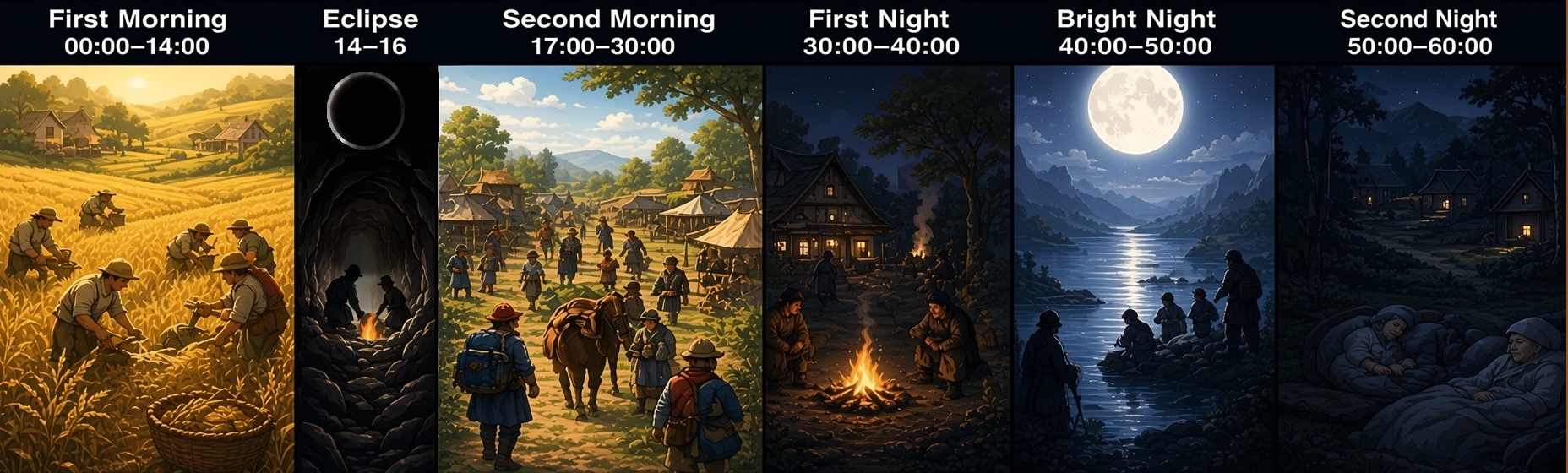
A good rule of thumb when converting TheWorld periods of time into more “Earth-like” units (when D&D reference books cite values more than one hour) is to use the standard methods listed here. For example, to calculate a hireling’s expected wages, treat one 8-hour Earth “day” of labor as equal to one TheWorld “Verkstundr.” If skilled labor costs 2 gp per Earth day, then multiply by 2.5 Verkstundr to arrive at 5 gp per TheWorld Dag. If a task takes 365 Earth days to complete, divide by 2.5 to arrive at 146 TheWorld days.
Likewise, since ThePeople pay very close attention to the subtle differences between their five Säsonger, they do not track the long passage of time in years but instead in Säsonger. If needed, players can divide these “larger season” numbers by 4; that is approximately how many Earth years’ worth of time is being discussed. For example, the 162-Season World War waged on TheWorld lasted slightly more than 40 Earth years. Likewise, humans here might expect to live 400 Säsonger, goblins 325, halflings 600, dwarfs 1,400, gnomes 2,000, and elves 3,000.
There is not much localized temperature and climate variance during the 180-World-day year in the population centers on TheWorld, but there are five distinct seasons: a cold winter period (Kallliga), a cool spring (Svalsådd), a warm autumn (Värmskörde), a warm second spring (Värmsådd), and a cool second autumn (Svalskörde). Crops can be planted and harvested at any time throughout the year, but the periods between the spring and autumn pairings see the most growth, while the winter season sees the least—sometimes very little. People typically leave fields fallow one or two seasons out of every five.
Most of the known habitable land of TheWorld is centered and massed at the equator on the side of the moon facing the gas giant. These lands are varied by altitude, with a goodly mix of grasslands, forests, deserts, taigas, and tundra surrounded by vast and dangerous oceans. Smaller continental landmasses and large islands exist farther from this land center. There are also a significant number of habitable, near-surface caverns and even deeper subterranean realms (with no direct connections between them) known collectively as “The Moulded Grotto”). Little, if any, is publicly known of the opposite side of TheWorld, but it is rumored to be a dry, barren, and overly volcanic realm.
There are convincing first-hand accounts, cultural histories, legends, and much physical evidence to suggest TheWorld coexists with similar “nearby” realms that are also capable of supporting life. Some argue that these worlds “overlap” each other multidimensionally, while others believe these realms actually exist on neighboring moons, distant planets, or even different universes. Wherever these realms truly exist, travel between them has been found to be possible at certain times and locations (these are known in various cultural languages as “faults,” “veils,” or existing “along ley lines,” seams in the architecture of creation).
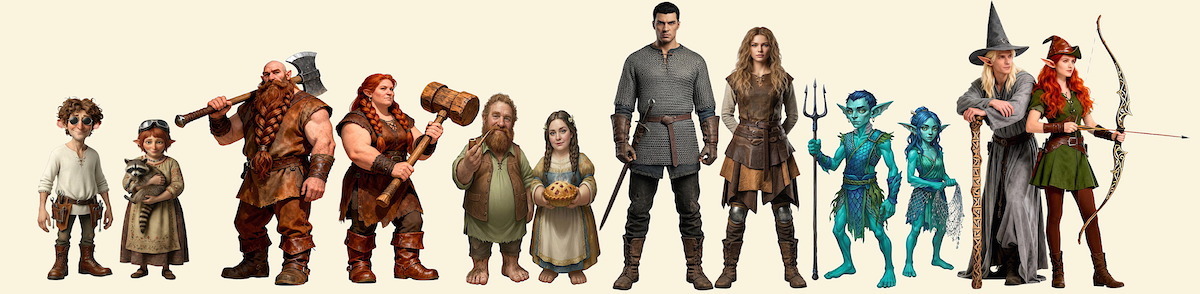
There are many sentient humanoid species occupying TheWorld (too many, most believe, to have evolved here naturally). As the most common people in this D&D world are humanoids—gnomes, dwarfs, halflings, humans, vattenpukje, and elves—those are also the expected player-character options for this campaign setting. (Some exceptions may be made in each major location; for example, lizardfolk in the southwest, yuan-ti in the east, and ogres in the southeast.) Interbreeding is possible among most humanoid species, but mixed offspring on TheWorld tend to favor the species characteristics of the mother; as such, there is no half-elf, half-orc, tiefling, or dragonborn “species” in this campaign setting, though some unique instances of these may exist.
The most common and numerous people living on the surface of TheWorld are humans, who breed and mature quickly but are also relatively short-lived. Because of this, humans tend to be overly ambitious and determined to "leave their mark” on TheWorld. This is also true of other short-lived species, such as pukje (goblins) and ogres. The longer-lived species, such as elves (due to cyclical reincarnation), do not mature quickly nor have many viable offspring. Long-lived species in general seem less driven and less ambitious than humans, preferring instead to slowly sample everything life has to offer; while some others, like dwarfs, tend to be singularly focused throughout their long lives and enjoy working toward perfecting only one or two of life’s pursuits.
Alignment (represented by terms like Lawful Neutral, Chaotic Good, etc.) is a self-imposed behavioral goal. It is not meant to be a player or class restriction in this setting. It is role-playing. Although various species gravitate toward certain behaviors, alignment is up to each individual (and player) to determine what is right and wrong ethical behavior and the correct attitude for their own characters and friends. But of course, city states, deities, and other individuals may have opposing ethics:
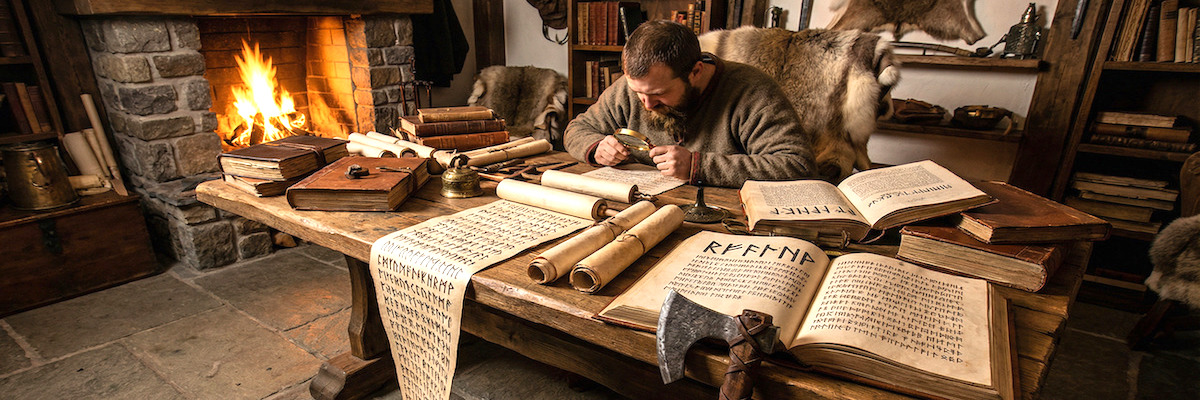
The technology of TheWorld is roughly equivalent to that of Earth circa 1100 AD, with the following improvements:
Resources are generally quite good and plentiful (in comparison to population numbers), but these resources are not always universally distributed throughout TheWorld, which provides great opportunities for global trade and commerce—yet it has also been the largest contributing factor behind envy and most every prolonged war.
In TheWorld, social structures manifest through diverse frameworks. Among humans in the northwest, the Peerage defines aristocratic stratification, with earned titles and inherited lineage shaping the ranks of lords and ladies. In the desert oasis realm of the northeast, the Qadimate enforces a rigid social order rooted in ancient traditions and titles like Emir and Sultan, intertwining nomadic clans of the Ökenveld with yuan-ti serpentine lineages. Among giants and ogres in the southeastern plateaus, the Ordning imposes a rigid power order based on strength and cunning, from the mightiest overlords to the lowliest underlings. The market-driven cities of the southwest thrive under a Guildocracy, where standing depends on profitable transactions and guild affiliations—Masters, journeymen, and apprentices—while those outside the trades, known as “outliers,” lack formal prestige yet weave through the transactional web.
Most of TheWorld is controlled by four major political city-states: Frittlandr, Ökenveld, The Rimemarch, and Svartaland.
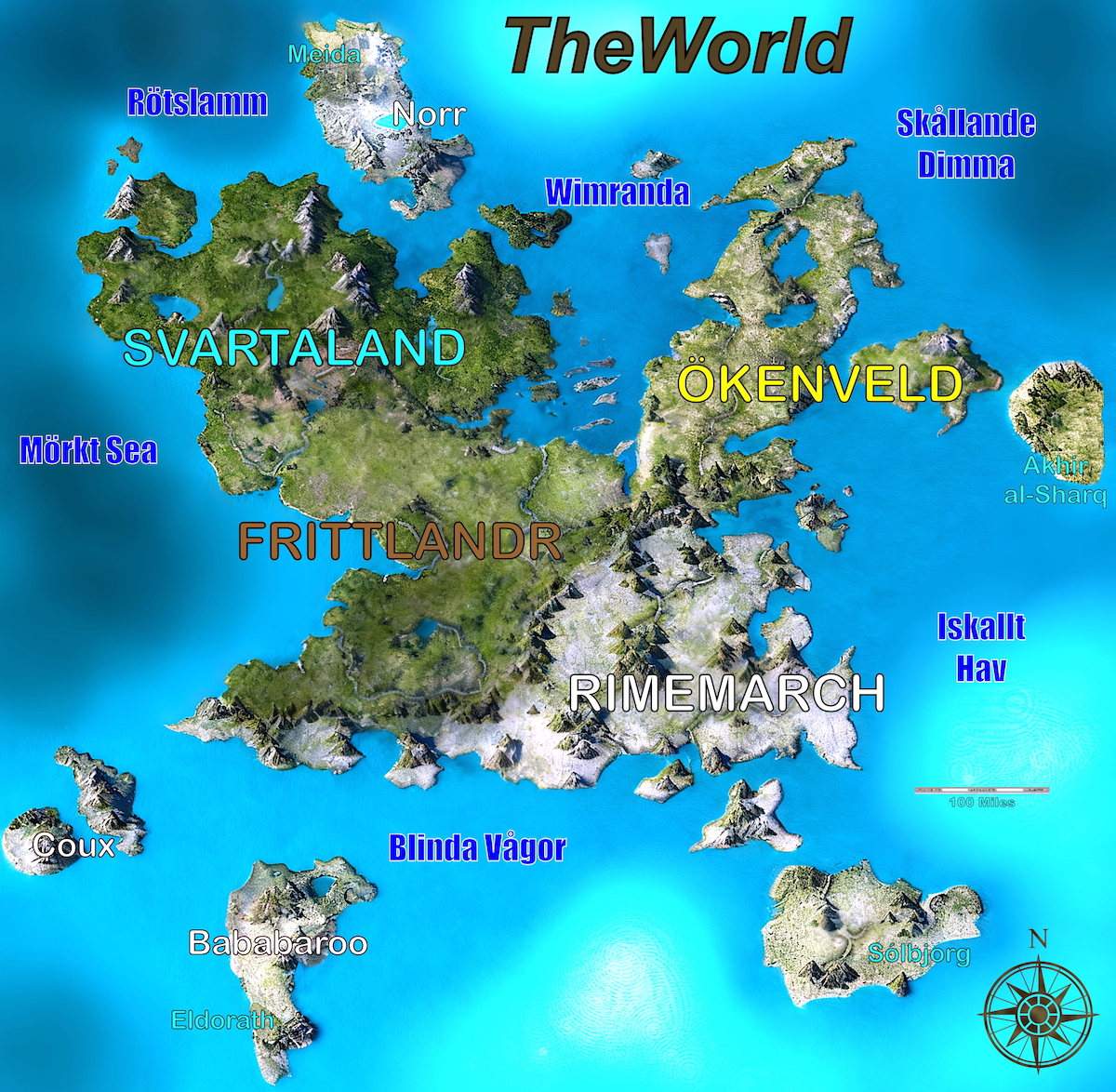
The Frittlandr region in the southwest has been historically known as Grans Korsning by its neighbors. That name essentially meant “The Crossing Point,” and Frittlandr was called that because the other city-states routinely marched and pillaged through it, resupplying on their way to fight the others. In recent generations, however, an unlikely alliance of local humans, elves, dwarfs, lizard folk, goblins, and ogres had enough of that, and they fought together to successfully repel all invaders. Now referring to themselves as “the free lands,” this area of TheWorld is well on its way to becoming a republic, but it also has a powerful merchant class whose wealth effectively gives them nobility-like status in the major cities.
The Ökenveld people rule the arid northeast, where opulent oasis cities serve as strongholds for cunning rulers who blend lavish courts with austere meditative disciplines. Vast dune seas and barren badlands shelter fierce nomadic human tribes who live by ancient codes of honor and survival. Ökenveld also harbors a significant number of scheming yuan-ti (snake people), savage gnoll warbands (hyena people), brutish quaggoth clans (cave bear people), and enigmatic thri-kreen hunters (insectoids) who roam the dry grasslands with deadly precision.
The Vildar are a savage people in the southeast residing in the colder realm known as the Rimemarch. Populated by an equal mix of humans and giantkin, the Rimemarch is a loose political alliance of chiefs, warlords, and jarls. Occasionally, strong, charismatic regional leaders arise and take national power. Historically then, the Vildar people unify to collectively raid, warring against their neighbors. But these brutal rulers disappear (are often assassinated internally) almost as quickly as they come to power. Darker, more calculating forces exist behind the scenes, the foremost of these being the Punaiset Taikurit, an order of ogre magi.
The Svartriki people control the rugged agricultural lands in the northwest, known currently as The Queendom of Svarta or typically just Svartaland. Queen Ingagerd Hardrada is the ruler, and the Hardrada family has been in charge for a dozen generations. Populated mainly by humans and halflings, Svartaland is also home to dwarfs, kobolds, and myconids (a fungus-based life form who live beneath the surface). Svartaland is known for having the strongest horses in TheWorld. The Hardrada family, in ages past, employed dragons for mounts.
Centered at the equator in the Winrande waters are quite a number of small islands where political control has changed frequently over the years; so much so that the residents either consider themselves independent, work with the controlling forces du jour, or wage open and/or secret revolutions against them.
Well away from the central landmass, there are three independent lands of note: Norr, Coux, and Bababaroo. Each has difficult-to-reach port cities (mostly controlled by pirate kings) that manage some trade in raw resources. Historically, little has been known of these ports, let alone the interiors of these more distant islands. This has recently changed as powerful magic has been active in these locations.
Some time during the war (when attentions were focused inward), extraordinary magical forces “grafted” four new landmasses onto TheWorld. The why and how behind this is currently of great concern. Those living closest to (or those discovering) the new lands have given them names:
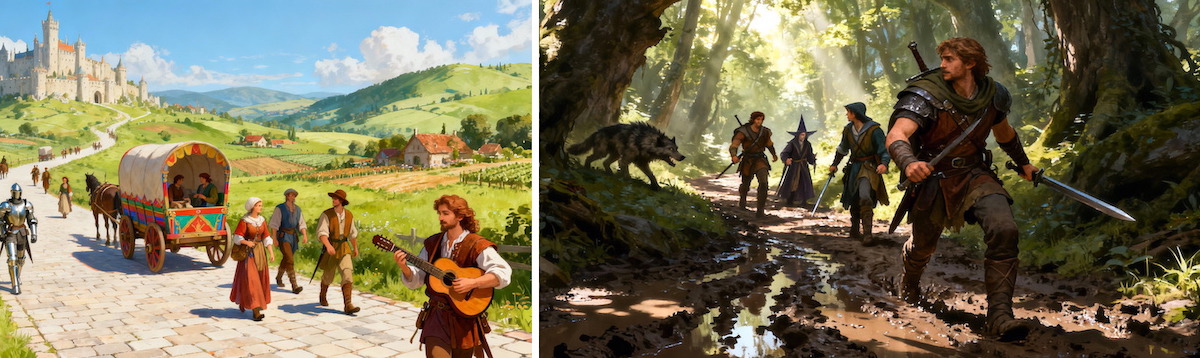
Since the disposition and demeanor of the regions of TheWorld vary, it follows that the quality of life of its people would also vary accordingly. But no matter the authority of a region, it’s a safe assumption that the poor and the ignorant have it the worst. Historically, throughout TheWorld there has been a large underclass of manual workers who labored for others and were mostly always hungry. Even among the children of the wealthy elite, there were few ideal opportunities for the youngest siblings in a family, although they typically could find some professional work as soldiers, guards, sailors, and so on. Many would-be adventurers also rose out of these numbers, as years of turbulent and destructive warfare provided opportunities for the intrepid (and clever) to “rediscover” what had been overlooked or gone missing among the ruins of once-thriving communities. However, now in an age of world peace and with the rise of “bastion economics”—more privately owned and government-sponsored capitalism—conditions are improving at every level of society.
Settlements on TheWorld usually are not densely populated. A thorp will typically have fewer than 80 people, a hamlet fewer than 400, a village fewer than 900, a small town fewer than 2,000, a large town fewer than 5,000, a small city fewer than 12,000, and very few large cities with 25,000 people. In general, though, the larger the settlement, the better the roads leading to and from it, and the better the chance these roads will have fighters and regular patrols helping to protect pilgrims and traveling merchants. The opposite is also true, of course: less populated areas cannot always afford to keep their roads safe. But as a rule, most roads are safe to travel.
The same cannot be said of off-road travel; any number of beasts and ne’er-do-wells may be lurking in dense wooded areas, desolate hillocks and mountains, within deep valleys or caverns, or in the seas and oceans. There far more wilderness areas on TheWorld than settled societies, and many other non-humanoid or extra-humanoid races are believed to populate these “wildernesses” and make themselves known especially in periods of darkness. Travel on land or sea during the eclipse or first and second night periods is never recommended. Most "civilized" humanoids (even those with dark vision or twilight vision) have been culturally conditioned to rest during those times under the safest conditions they can find.
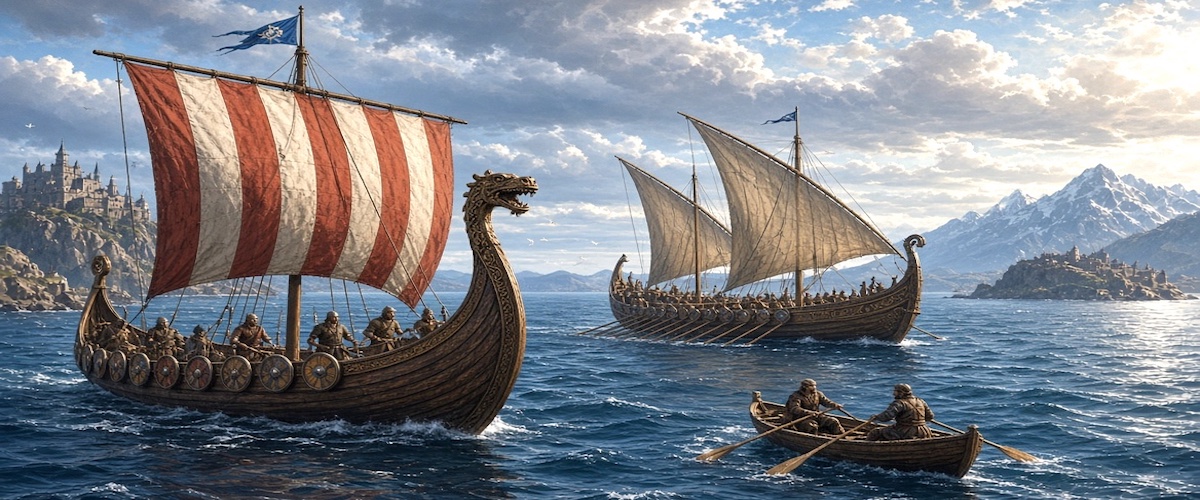
Typical Ship Information
| Ship Type | Pace | Movement / Speed | Hull AC | HP (DT) | Crew/Creatures/Cargo |
|---|---|---|---|---|---|
| Longship | 5 mph | Oars 20 ft or Sails 45 ft: [15 ft (into wind), 60 ft (with wind)] | 15 | 300 (DT 15) | 40/100/10 tons |
| Knarr | 4–5 mph | Oars 15 ft or Sails 40 ft: [15 ft (into wind), 55 ft (with wind)] | 15 | 300 (DT 15) | 3–10/10–17/20–30 tons |
| Galley | 4 mph | Oars 30 ft or Sails 35 ft: [15 ft (into wind), 50 ft (with wind)] | 15 | 500 (DT 20) | 80/40/150 tons |
| Warship | 4 mph | Oars 20 ft or Sails 35 ft: [15 ft (into wind), 50 ft (with wind)] | 15 | 500 (DT 20) | 40/60/200 tons |
| Sailing Ship | 5 mph | Sails 45 ft: [15 ft (into wind), 60 ft (with wind)] | 15 | 300 (DT 15) | 30/20/100 tons |
| Keelboat | 3 mph | Oars 20 ft or Sails 25 ft: [15 ft (into wind), 35 ft (with wind)] | 15 | 100 (DT 10) | 3/4/0.5 tons |
| Rowboat | 3 mph | Oars ~15 ft | 11 | 50 (no DT) | 2/2/0.25 tons |
| Dreki (Air) | 5 +4 mph | SoulDrive 40 ft + Sails 45 ft: [15 ft (into wind), 60 ft (with wind)] | 13 | 200 (DT 8) | 1/7/0.25 tons |
| Dreki (Water) | 4–5 +3 mph | SoulDrive 30 ft + Sails 40 ft: [15 ft (into wind), 55 ft (with wind)] | 13 | 200 (DT 8) | 1/7/1.0 tons |
| Dreki (Sub) | 0+2 mph | SoulDrive 20 ft; 8 hours of propulsion and air per Long Rest | 13 | 200 (DT 8) | 1/7/0.25 tons |
Magic (although not widely practiced on TheWorld) is a force of nature and an integral part of the universe at large, as well as the inner realms and those beyond. All creatures and things, in harmony with creation and recreation, contain a certain amount of "Spirit" magic diffused within them. Some are able to use this internal magic to manipulate reality by connecting with (and then channeling) other sources of magic. Manipulation of this sort is referred to as "casting spells," "innate spellcasting," or "utilizing creature or class abilities."
Typically, Casting involves at least one of Verbal (spoken incantations), Somatic (specific gestures done), and Material (sympathetic physical objects) "components." Innate Spellcasting is similar but there is never a need for Material Components. Abilities are just "always on" or are triggered naturally or by assuming a state of mind.
Magic spells are often classified into three types: divine, primal, and arcane. However, these classifications are ultimately as much about the spell casters (and their purposes) as it is about the specific sources that help energize them.
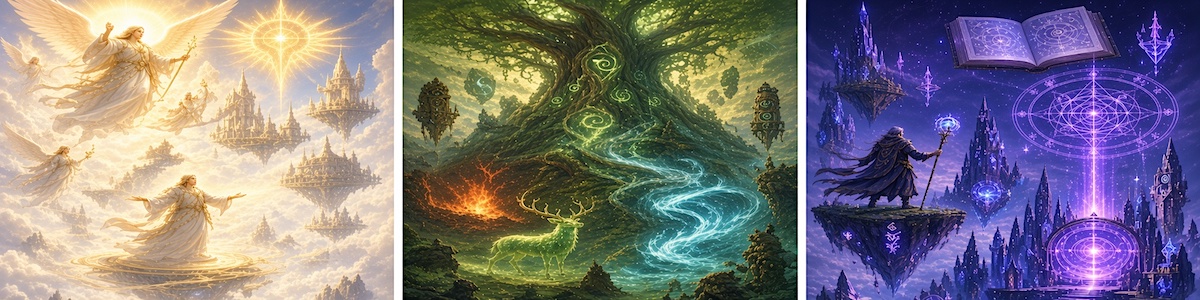
Spells categorized as divine are not actively researched by the spell caster but instead become known to the user through a deity or (in extremely rare cases) through spiritual inspiration alone. Characters who choose to be clerics most often worship a specific deity; they must also serve as a champion for a specific domain (if there is more than one) associated with that deity. Each domain has a list of additional spells and extra abilities, which the cleric gains at the level indicated. A cleric’s domain spells are always prepared, and they do not count against the number of other cleric spells a cleric may prepare each day.
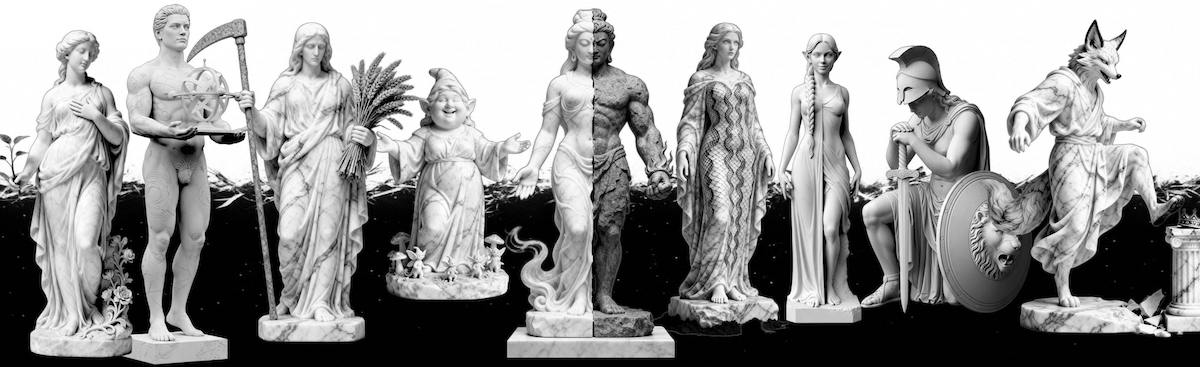
There are ten divine domains associated with TheWorld (listed here paired with its opposition domain; click on the domain name for specific mechanics):
Although the domains and names of deities are common knowledge—and their general desires and relationships with the other gods are understood—it is said that their vast perspective and obligations focus on a cosmic scale. Direct communication with them, therefore, is rare and often veiled in cryptic signs or mediated through divine agents. Traditional D&D “spiritual guidance” spells such as Commune, Divination, and Augury are less reliable in this setting than players might hope; divine insights are elusive and typically shaped by the gods’ broader, universal concerns and obligations.
Spells categorized as primal draw on the precarious balance and eternal struggles between elemental substances and cosmic forces. Druids, rangers, some sorcerers, and "monsters" are able to harness primal magic and redirect it as prepared spells or innate creature abilities.
Magic spells categorized as arcane must be actively researched by the spell caster (either by creating the spell themselves whole cloth or by threading one together from the records or songs of others who have come before them). The inception and the how and why of spells is not fully known. There are competing ideas and conflicting histories among sentient races, cultures, and individuals, but magic spells do exist, they work, and they can be learned and taught in a variety of ways. Some are closely attuned to arcane magic and have innate abilities to use it without serious study; others need to struggle even to get meager results, while still others cannot work it at all and might even be physically resistant to it.
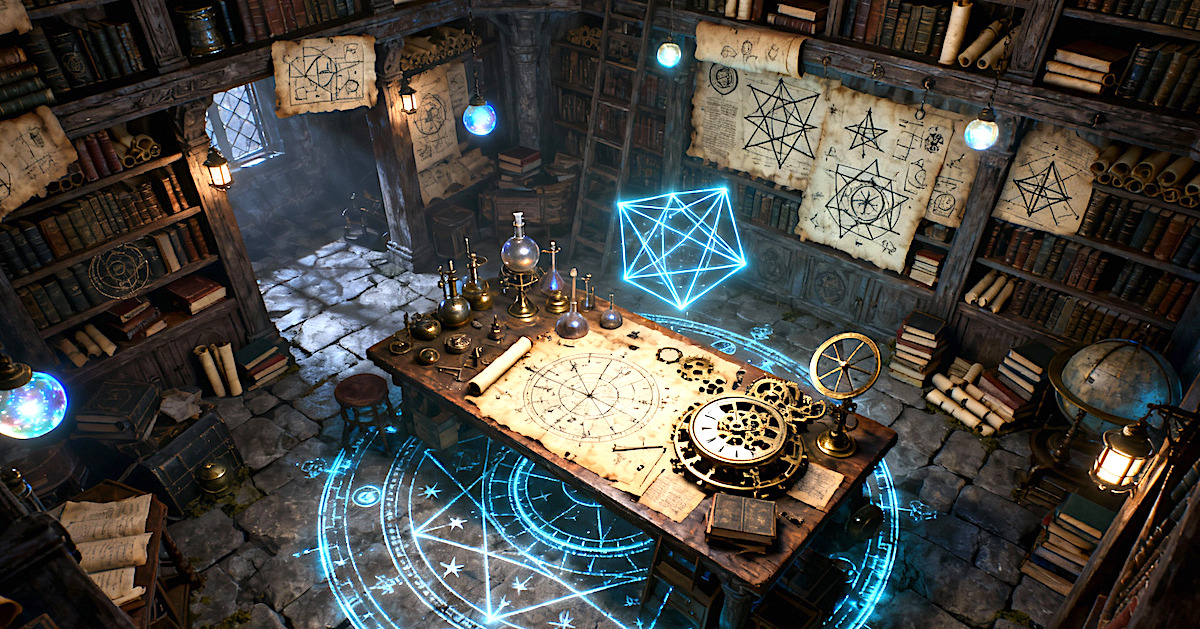
Throughout the ages, spell casters have developed and subsequently organized similar spells into categories called “schools.” Some spell casters (wizards) have opted to specialize in a particular school (arcane tradition) to satisfy their own preferences and/or to gain specific advantages; others (chancery magisters) have taken this to extremes and actively avoid learning the "distracting" spells and techniques from what they call “opposition” schools. Still others (arcanists) are able to harness great powers by focusing almost exclusively on arcane mysteries and contradictions. Bards, eldritch knights, arcane tricksters, etc., have discovered they have an affinity for learning and memorizing only certain categories of spells.
There are eight well-recognized schools of magic (here listed paired with its opposition school):
Much of what was known of arcane magic was deliberately kept secret and subsequently lost over time. To avoid this happening again, the modern schools of arcana build logically upon a common foundation of spell techniques and casting procedures. Unfortunately, the minds of spell casters, their ability to memorize, the mnemonic shortcuts they employ, and their best practices (to optimize the speed at which they can cast spells) have led them to creating highly personalized/optimized spell books best suited for them alone. Characters who have developed wizard as their professional class, however, are able to make sense of another wizard’s spell book given adequate time and resources. Afterward, they are able to copy each desired spell into their own unique spell book once they have decoded and mastered the needed techniques. Non-wizard spell casters can rarely make much sense of such tomes, but studying them may help to inspire their own training anyway.
As most wizards are not deliberately obtuse (and generally need money more than they need to maintain the secrecy of their research), they well realize that a secondary market exists for them to share spells with other wizards and to teach non-wizard spell casters how to gain access to magical spell concepts. To this end, beyond crafting optimized spell books for their own use, most wizards formalize and collect their research notes for resale. Many also have agreed to use the Arcane Standard Codex for Incantation Interchange format to create teaching tomes (commonly referred to as grimoires). These codexes use a sectional approach to recording spells. Each mystic record starts with Spell Name, followed by a brief Description of what the spell does. Then there is a Synopsis, a formal description of how to “run” it and which “options” the spell takes. Following that is a more textual description of the spell’s functionality and purpose, then some examples of usage. A list of related functionality follows, and then—with less structure—a collection of historical notes concludes with bug fixes, environment- and source-magic calls and returns, authorship, and even copyrights.
Two different wizards may have two different ways of achieving the same results with a single spell effect. This is because specialists in one magic school will be more familiar using their own “energy sources” and procedures. Properly recorded, a magic spell using the ASCII sectional approach would include all of the known magic-school variations of the same spell, if possible—and as such collect a vast amount of text and diagrams distributed across many pages in a nice, unified, well-preserved tome. This is what all student and self-practicing spell casters wish to stumble across, be they wizards, arcane tricksters, eldritch knights, or bards. But even today, these massive tomes rarely ever leave the shielded vaults or guarded libraries of their owners. Still, wizards and magic schools can sometimes be found who are willing to sell “visitation rights” to peruse and copy information from these collections while visitors are onsite.
Selling Spells Books: although spell books may be considered priceless to those carrying them, there is often little resale value for discovered or captured (non-Grimoire) spell books on the open-market. Lining up eager buyers who are willing to buy a specific wizard’s traveling collection just so they can begin decoding a spell or two inside of it is highly unlikely. Instead, a specialities merchant might offer one low rate: typically one half (5 gp per spell level) of what it would have cost a specialist Wizard to have scribed copies of their spells. The purchased tome then is disassembled, and, after considerable effort, individual pages are eventually sold or donated.
There are at least three types of curses possible in this campaign setting:
Only the first type of curse can be magically detected with Detect Magic and then removed using Dispel Magic. Typically, the curse upon a cursed item is activated only when its specific "trigger" is met—for instance, the item is used as intended (Example: a sword is used in battle), a person wears or attunes to the item, or a special condition (time, place, etc.) is met. The Identify spell itself almost always fails to detect if a magical item is cursed. But the item’s appearance or manner may provide a clue, as might the mental or physical characteristics of a previous owner, whether this was observed firsthand or learned as rumors or written into legends. The spells Legend Lore, Wish, Augury, Divination, Commune, and special abilities or specific magic items might reveal something about a curse. A Remove Curse or a Restoration spell usually works on removing a curse of the first type. Curses of the second type, if they can be removed, often require upslotted-castings of “Remove Curse”-like spells. Usually a Wish spell is required to remove the third type of genetic curse. Generally, the longer that someone or something has had a curse, the more difficult it is for the person or item to be free of it.
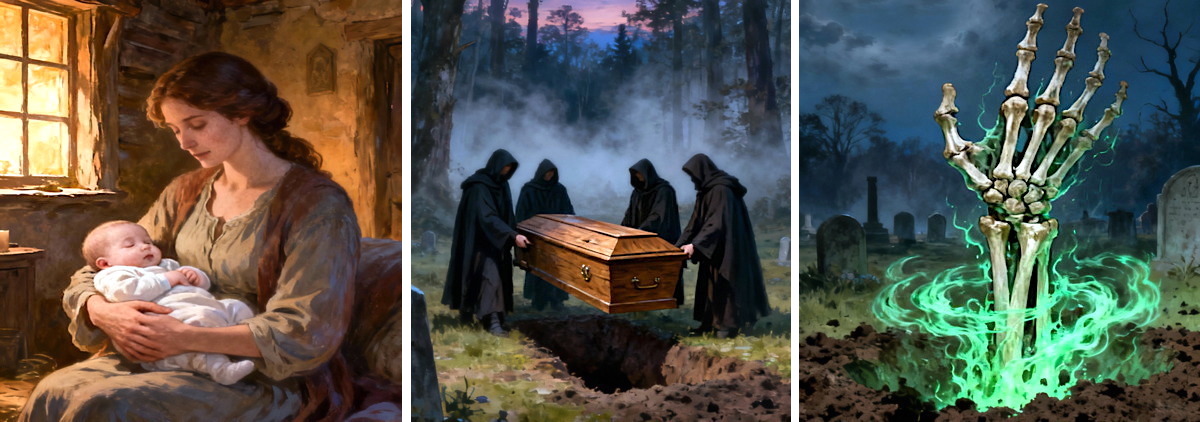
Life is a vital force that involves growth, development, and change over time. Living creatures sustain themselves by eating, drinking, and breathing, and they often seek to reproduce. The living are said to be “corporeal,” meaning they are composed of mineral, vegetable, and animal components (Bein, Viðr, and Lá), which combine into a physical body known as their Lík or Lich. These components correspond approximately to a person’s Strength, Constitution, and Dexterity.
Many creatures also have a “non-corporeal” body composed of semblance, soul, and spirit components (Litr, Óðr, and Önd), which together form a metaphysical body known as their Essen. These three are often collectively (and erroneously) referred to as a person’s “soul.” The Litr is the divine form—an inner belief that shapes outward appearance, presence, and influence (Charisma). The Óðr is the seat of consciousness, wit, and psyche (Intelligence). Önd is the animating breath or ghost (Wisdom), the vital connection between the individual and the rest of creation.
Typically, all living things will reach a point at the end of their physical life cycle where there will be a cessation of all vital functions of their corporeal forms. Less well known is that there is a similar degeneration of their Essen over time and/or due to traumatic events. At some point, death occurs and the physical and the Essen bodies begin to decay and separate into their component elements. Certain magic can be deployed to delay physical decay, and other magic (many believe) can restore a creature’s departed Essen to their corpse, restarting life (or at least some semblance of life).
Not everyone holds that a creature returned by these divine, necrotic, or primal transmutation magics is actually the original creature returned. Some insist that it most certainly is, while others persist in believing that some new spirit, or mental illness, or perhaps even a different soul entirely has taken possession of the host body—having beforehand consumed the original soul (thus gaining access to previous memories and personalities, enough so that it may pretend to be the original person). As such, there is societal stigma found among the general public regarding Raise Dead, Resurrection, and Reincarnate spells (although Revivify is most often seen as just super-healing a “not quite dead” person).
Also, the various “raise” spells tend to be expensive (requiring the sacrifice of precious diamonds—and sometimes a single diamond of great purity and expense), and the spells themselves have time limitations on when they can be cast effectively. So while some might be able to afford the expense, they may not be able to obtain the quality diamond(s) in time for such spells to be effective. They may also face local legal restrictions: for instance, an executor of the estate of the deceased or an otherwise-inheriting family member might object to the person who has been pronounced dead suddenly returning. A legal identity might be difficult to reestablish once a person is known to be dead—and any claim made after death to any previously owned possessions might not be honored.
There is also the issue that these “raise” spells don’t always work. These particular magic spells might fail in this campaign setting for a number of reasons: (1) the person died of old age, (2) the Essen might not wish to return, or (3) the Essen might be unable to return (someone or something may have already made a claim on the Essen of the deceased and will not allow it to return). It is also possible that the previous host body may not be able to “survive” the return experience; the Lík or the Essen may not be able to endure the system shock of returning to the body (or possibly to a clone of the original host body). Furthermore, each time a separated Essen reconnects with a living body, it may become damaged or corrupted, losing memories or cognitive skills. Also, something else might interrupt or go wrong with the actual “raising.” As such, the magic tends to only be attempted if every sign and portent appears favorable and legal—and the money has been paid upfront. There are no guarantees the caster of the “raise” can make, and a contract is usually signed to this effect by the customer.
Once a creature has lost its life, it begins to deconstruct into separate components, although some of its corporeal and non-corporeal components may continue in a semblance (or mockery) of life known as undeath. For example, while the corpse/Lík of a creature decays, it may yet cling to a portion of its soul (memories and knowledge of its former life), which can be consulted by using special magic such as Speak with Dead. Other spells such as Animate Dead might also exploit the corporeal and lingering non-corporeal remains by giving them a new source of movement (breath) so it may carry out the will of the caster. It is also possible that the non-corporeal portions of a creature might linger on in the corporeal world after death as an apparition. Some combination of soul, spirit, or Litr, separated from its earthly Lík, may decide it has "unfinished business" that will not allow it to leave this realm or rest in peace. This refusal to “depart” might allow it to merge with the remnants of similar substances until such a time when its remaining earthly desires or fears have been sated.
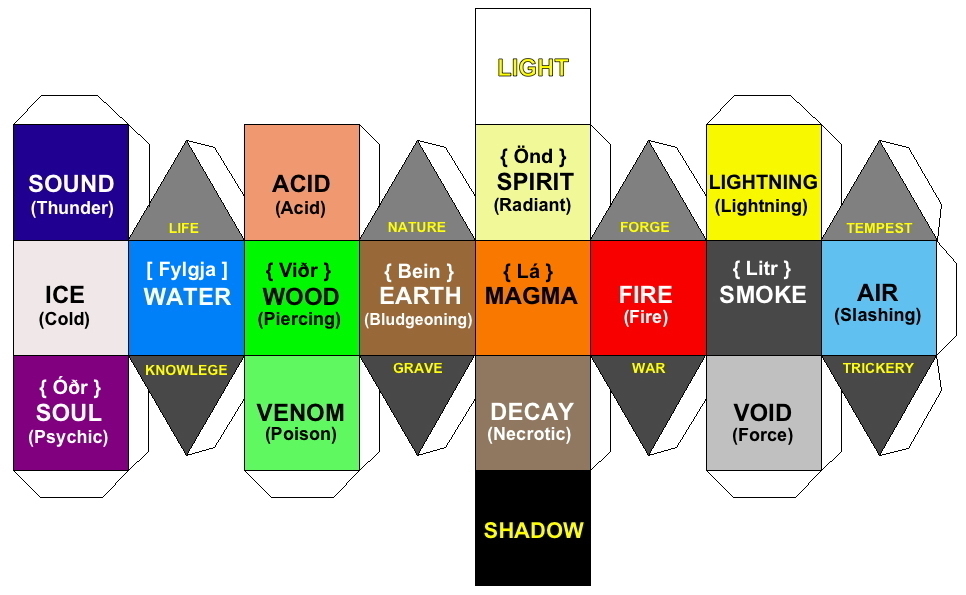
The four classical elements—Earth, Fire, Air, and Water—are the fundamental substances from which reality is woven. When any two adjacent elements blend in equal measure, they give rise to a para-elemental mixture: Earth with Fire yields Magma, Fire with Air produces Smoke (and/or Ash), Air with Water forms Ice, and Water with Earth creates Wood (and/or Ooze). These eight forces—four pure elements and four para-elements—form a great ring in the cosmos known as the Elemental Chaos.
Above this ring lies the syntropic plane of Light; below it, the entropic plane of Shadow. When the positive pull of Light or the negative spread of Shadow interacts directly with a para-element, an admixture (or quasi-element) forms. Thus are created the eight admixtures: Lightning, Acid, Spirit, and Sound from the influence of Light; Soul, Venom, Decay, and Void from the touch of Shadow.
Divine Domains—spiritual realms binding and sacred to the gods—have emerged at the intersections where pure elements co-mingle with two admixtures. And, within the balances and surrounding tensions of the elemental ring, most mortal life has risen and endures. Living beings are woven from materials gained from these elements, para-elements, admixtures, and domains.
A mortal’s physical body, called the Lík, is composed of three corporeal aspects drawn from the Elemental Chaos:
To this earthly frame the gods add three divine gifts—together called the Essen:
Additionally, many traditions hold that individuals may be accompanied by a fylgja—a distinct second soul, not the person’s own, yet inextricably bound to them. The fylgja shares the individual’s consciousness, advises in decision-making, and records every action taken with impartial clarity. She will one day bear witness—speaking either for or against you—at a shared final judgment.
Upon death, the Lík begins dissolution into its separate components, returning eventually to the great ring of the Elemental Planes. The Essen may likewise separate over time, its aspects dispersing into the cosmic order, or it may have cause and divine permission to journey intact to one of the Divine Domains. Thus every thinking creature stands at the intersection of elemental mixture and admixture, body and essence, Light and Shadow—a fragile, wondrous synthesis of the entire cosmic order.
Travel between these realms of reality by the living is made possible through the admixtures. Astral projection, or soul travel, allows the Óðr to traverse the planes as a projected consciousness, temporarily leaving the physical body behind (then, perhaps, pulling this body to a distant destination). Ethereal jaunts, or spiritual travel, draw on the Önd to phase travelers and their gear through the interconnected webs of reality, slipping between material overlaps and residual ley lines boundaries like breath through mist.
The rhombicuboctahedron shape of our universe enfolds the core of creation, its faces delineating the bounds where mortal realms touch the veiled infinities within—and beyond. From those outer voids—spaces of unfathomable depth, impossible angles, and alien geometries—intrusions sometimes manifest as twisted shadows upon our three-fold material plane: flattened silhouettes of truer, extra-dimensional beings that strain against both our comprehension and the lattice edges of reality itself.
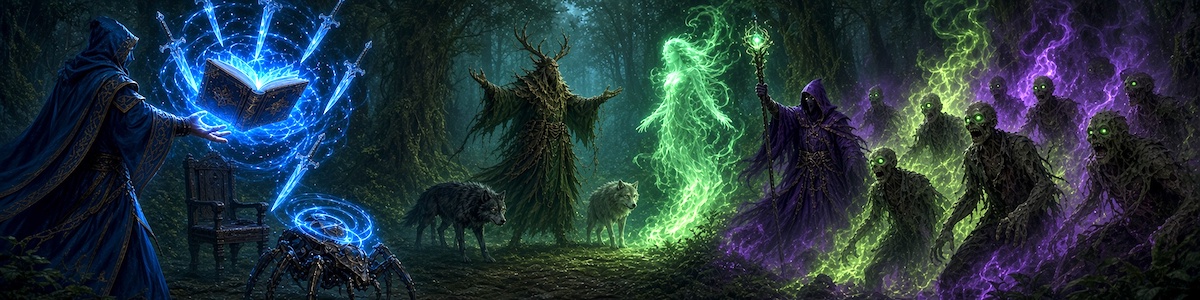
Various spells, especially Transmutation spells such as Animate Objects and Tiny Servant, create an animating force that is thematic to the material of the target (and often to the material components of the spell). This force is most frequently drawn from, or heavily flavored by, the life force / essen of the caster. Spells such as Animate Dead take formerly living creatures and reanimate their corpses using entropic (shadow / necrotic) magic. Other spells, such as Find Familiar, the various Conjuration spells, and the Summoning spells, use the spell’s material components (or the surrounding environment) to form temporary living bodies. These bodies are then paired with syntropic Önd (animating spirit) borrowed from aberrant, celestial, elemental, fey, or fiendish sources.
In all cases, the caster remains tethered to the creation through the spell’s Concentration and Duration. This tether shares a portion of the caster’s own essen (spirit, soul, and semblance), which is what allows communication, an instruction set, and control. In some instances the spirit that answers the summoning may be the same one that the caster has called previously; in other cases, it may only seem the same because of the strong imprint left by the caster’s investment of essen.
When any of these animate objects, constructs, summoned creature avatars, or reanimated corpses are reduced to 0 hit points, the animating force dissipates and returns to its source. The physical form then fades, blinks out of existence, dissolves, or reverts to its original inanimate or putrefied state.
Hit points represent a creature’s total capacity to endure harm before its Lík (physical body) and Essen (metaphysical gifts) can no longer sustain coherent function. They reflect the combined resilience of the corporeal Lík (woven from Bein, Viðr, and Lá) and the divine Essen (Óðr, Önd, and Litr), strengthened by the spiritual magic that connects everything to the greater cosmos. Robust physical components grant endurance through sheer toughness, while a strong Essen allows one’s inner magic to sustain the body far beyond what raw flesh and bone could manage alone. When a creature is reduced to 0 hit points and then dies, its Lík and Essen begin to separate.
Damage has come to be understood as observed manifestations drawn from the Elemental Chaos, its para-elements and admixtures, and the opposing extremes of Light and Shadow. Generalizations of the different "types" of damage are meant to serve as useful cosmological and scholarly categories rather than exhaustive physical and magical laws.
Physical Damage (primarily harms the Lík)
Elemental and Admixture Damage
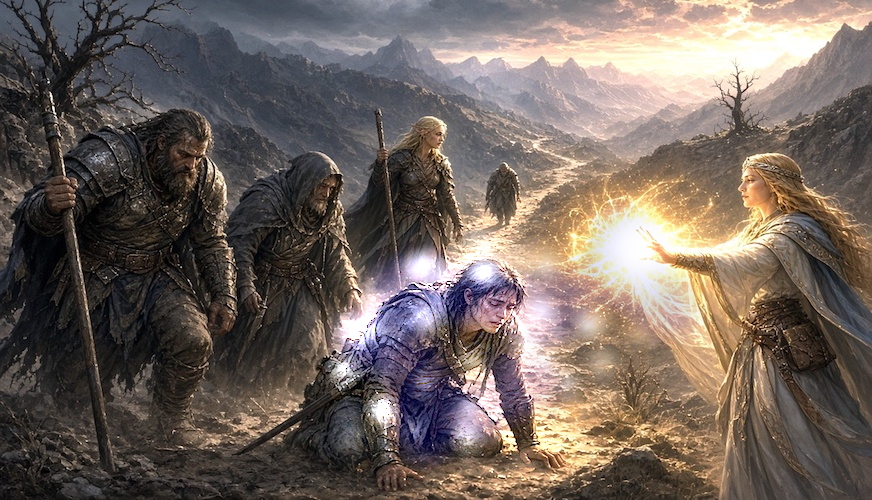
Exhaustion refers to a cumulative state of extreme physical or mental fatigue; it is measured in six levels.
Exhauston is caused by forced marches, starvation, dehydration, extreme environments, and other hazards. Characters can normally travel or physically or mentally exert themselves for roughly 8 hours (per every 24 hours) without penalty. However, prolonged activity, combat, and repeated action beyond this (grouped together under the terminology Exertion aka Forced March) are realistically tiring. After 8 hours of exertion, each additional hour requires a Constitution saving throw (DC 10 +1 per hour past 8) at the end of that hour. Failure adds 1 level of Exhaustion.
As fighting for one’s life is especially tiring, a lengthy combat (lasting 6–15 rounds) adds 1 hour of exertion to a character’s cummulative total. More extensive melees (16+ rounds) add 2 hours (or more). Additionally, any sustained physical activity, such as swimming and climbing (unless the character has a Swimming or Climbing speed), or magical spell exertion, such as repeated casting of cantrips for utility count toward the hourly exertion totals at the same rate as combat (roughly one hour per minute).
Traveling speeds outside of combat already have avoiding-fatigue factors built in. Instead of of calculating miles per hour, use normal Pacing rules for characters, mounts, and ships:
Finishing a long rest reduces a creature’s exhaustion level by 1, provided that the creature has also ingested some food and drink. A short rest will reduce hourly exertion totals by 2 hours and a long rest will reset them to 0.
Restoration (replaces Lesser Restoration and Greater Restoration in this campaign setting)
You touch a creature and can cure one disease affecting it, or alternatively, you may end the blinded, deafened, paralyzed, or poisoned condition.
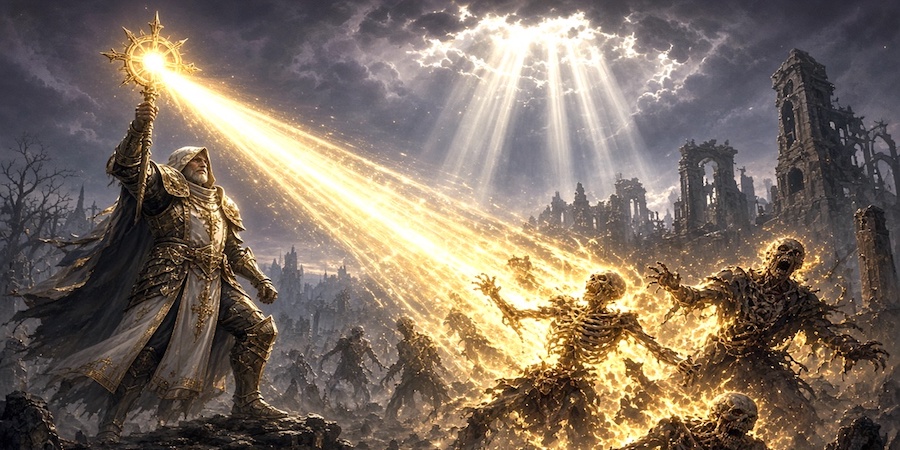
"Turn Undead": Beginning at 2nd level, clerics in this campaign setting may use an action to Channel Divinity to present their holy symbol to censure undead. Any undead targeted within 30 feet, must make a Wisdom saving throw. If the creature fails its save, it gains the Frightened and Incapacitated conditions for 1 minute. For the duration, it does its best to move away from the cleric. (These effects end early if the creature takes damage or if the cleric dies or becomes incapacitated or the holy symbol is removed).
"Sear Undead": Beginning at 5th level, clerics employing Turn Undead may also elect to cause any undead failing their saving throw to take 1d8 (or up to a number of d8s equal to their Wisdom modifier) of Radiant damage. Damage taken in this manner does not end the turn effect
"Burn Undead": Beginning at 9th level, for up to nine rounds after using Channel Divinity to Turn Undead, as a free action, clerics can press on zealosy and inflict radiant damage equal to their Wisdom modifier to any Undead within 30 feet of them. This additional damage, however, will end any other effects of Turn Undead.
"Divine Intervention": Beginning at 10th level, once per Long Rest, a cleric may choose any cleric spell of level 5 or lower that does not require a Reaction to cast. As part of that same action, the cleric can cast that spell without expending a spell slot or requiring material components. It is understood, however, clerics will make a sacrifice or offering equal to the gold piece value of those missing material components at their first opportunity.
"Greater Divine Intervention": Beginning at 20th level, when cleric use Divine Intervention, they may choose Wish to cast any spell of 8th-level or lower. If clerics do so, they cannot use Divine Intervention again for 2d4 Long Rests and until they have made an offering equal to the gold piece value of any material components their previous Wish normally would have required.
The Simulacrum spell does not create an independent being; it creates an illusion—a bound, imperfect reflection of the target of the spell (a “snapshot” of the target’s abilities, knowledge, and current resource state at the moment the spell completes). This reflection is magically sustained and tethered exclusively to the spell’s caster. The tether keeps the reflection “real” and forces it to obey the caster (not the original target).
Regardless of its spellcasting ability, a simulacrum is incapable of creating a new tether of its own. This prevents it from casting Simulacrum (even if the original had the spell prepared) and also prevents it from gaining a familiar if the original possesses one. Furthermore, because the simulacrum has no true independent existence, the consequences of any powerful reality-altering effect it attempts—most notably Wish, or class features such as Greater Divine Intervention—are borne by both the simulacrum and the creator of the tether.
The tether does not link the concentration of the caster and the simulacrum. Each may concentrate on its own spell independently. If the caster dies, the simulacrum continues to exist and remains tethered, still obedient to the last commands of its caster and any standing orders that remain.
At the moment of creation the simulacrum possesses the memories of the original target, and it continues to form and retain new memories thereafter. It can observe, remember, and adapt to an opponent’s tactics, environmental conditions, or other situational information. These adaptations remain practical only; they never result in permanent mechanical improvement (new levels, new abilities, permanent skill increases, etc.). The simulacrum cannot regain features that the original target would normally recover via a Short Rest or Long Rest (spell slots, ki points, etc.).
Although a simulacrum can gain temporary hit points normally, it cannot be healed or regenerated by any means. Its damage can only be repaired in an alchemical laboratory, using rare herbs and minerals worth 100 gp per hit point it regains.
Wish is not an ordinary spell. It is a direct, high-stakes, personal negotiation with the fundamental structure of reality. If the ability to cast Wish is bestowed upon a creature by an item or another creature, the Wish they cast (or have cast for them) is limited to the typical form that duplicates the effects of any spell of 8th level or lower, without the need for a spell slot or material components.
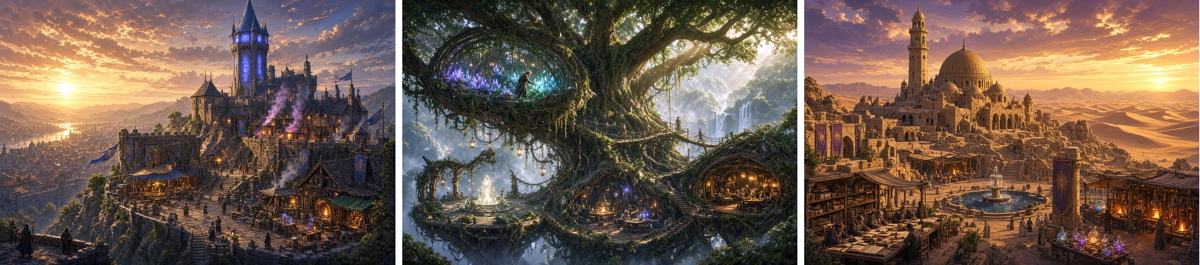
In this setting (and only very recently), bastions are City State sponsored locations entrusted to exceptional individuals—usually members of the Guildocracy (in Frittlandr), the Qadimate (in Ökenveld), the Ordning (in Rimemarch), and the Peerage (in Svartaland). The facilities at these locations serve as homes, provide services, generate wealth, and produce speciality items, including magical goods. A bastion can take almost any form: a castle, wizard’s tower, tavern, thieves’ guild hideout, shrine, greenhouse, sewer network, or whatever the exceptional individual wishes (within reason). The initial costs of these bastions and training and supporting the individuals who staff them is provided by the City State in which they reside. It is seen as a political imperative for the City State to remain relevant in TheWorld. Ongoing costs for bastions is then supported by taxes on what is produced and sold.